Finding Rollie Schweinsburg
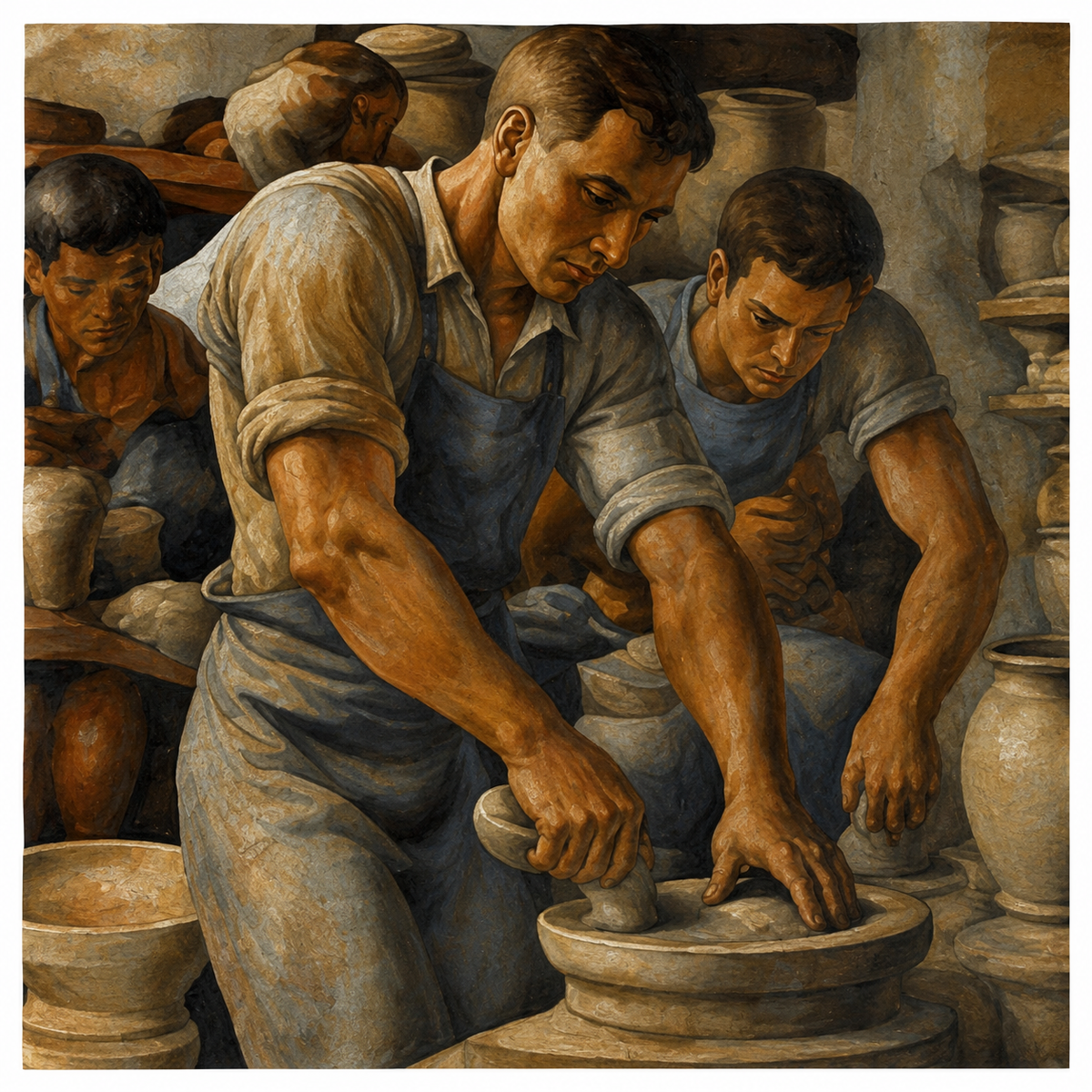
Somewhere in the last couple of weeks I seem to have accidentally wandered into a partially forgotten Ohio Valley industrial civilization centered around a painter named Roland Schweinsburg, operative potters, steelworkers, river commerce, WPA murals, and enough old newspaper clippings to keep a reasonably healthy retired person awake far later than common sense recommends.
At first I thought Schweinsburg was simply the fellow who painted those pottery-worker scenes hanging over at the Museum of Ceramics in East Liverpool. Most people around there maybe vaguely know the paintings and not about him at all. Men carrying saggars. Throwers at wheels. Kiln scenes. Historical decoration. Local culture. End of story.
Except it is not the end of the story at all.
The longer I look at these paintings, the stranger and more interesting they become because Schweinsburg was not really painting “pottery” so much as process itself. Everything revolves around work. Bodies lifting. Men balancing stacks of ware. Workers wedging clay. Kiln placers carrying material through dark industrial interiors. The rooms are accurate. The tools are accurate. The posture is accurate. Even the clutter feels functional. Nothing looks sentimental or invented. The operative workers themselves are the entire machinery of civilization in these paintings.
And most importantly, the owners are nowhere to be found. In most pottery histories the names of owning partnerships, makers marks, and sales figures are the focus.
That distinction matters because modern America increasingly seems unable to see labor except either as political abstraction or nostalgic decoration. Schweinsburg instead painted workers as skilled intelligence embedded inside industrial systems. The paintings respect competence. They respect process. They respect people who knew how to actually do things. This is something I thought of yesterday when Pope Leo spoke about new forms of technological slavery.
The Newspapers.com archive started making this clearer. I originally assumed the pottery-worker series was some isolated East Liverpool project, but then references began appearing to Butler Art Institute exhibitions, Carnegie Library displays, federal mural projects, Treasury Relief work, and eventually paintings titled “Steel Mills” and “Steel Machine Shop.”
Schweinsburg began looking less like a local pottery painter and more like a regional industrial realist documenting operative labor systems across the upper Ohio Valley during the Depression era. Which makes perfect sense once you learn his father was a steelworker in Youngstown.
And once you begin thinking that way, the entire region reorganizes itself in your head. East Liverpool pottery. Youngstown steel. River commerce. Railroads. Kilns. Furnaces. Docks. Machine shops. Towboats. Immigrant labor. Union locals. The Ohio Valley was not merely a collection of towns. It was an interconnected industrial organism. Not to mention Ohio River Valley geology and waves of immigrants.
What fascinates me most is that these paintings were displayed publicly while the industries themselves were still functioning. They appeared in department store windows and regional exhibitions while pottery workers were still walking home from the factories at the end of shifts. People were literally watching their own civilization being documented in real time. And it was a Big Deal.
Perhaps this also explains why I keep thinking about sustainability while looking at these paintings. Sustainability is not really about slogans or branding exercises. It is about understanding systems well enough to keep them functioning across generations. Healthy systems depend upon understanding relationships between labor, landscape, material, energy, and time. Do I find myself agreeing once more with the Pope!?
Schweinsburg appears to have understood that instinctively. The paintings are fundamentally about transformation. Earth into clay. Clay into ware. Ware into commerce. Labor into civilization. The workers remain visible throughout the entire process.
These paintings show people working hard at making things. The real infrastructure of industry had by the late 1930s not mostly been about factories themselves but about using the the accumulated skill and coordinated knowledge of the people inside them. Who knows about the 2030s?